How much EBITDA leaked out of your work orders last quarter?
It’s on your P&L. Just not in one place. It hides in the margin compression your CFO can’t explain. The G&A bloat you blame on growth. The DSO that keeps creeping. The revenue your techs earned but nobody invoiced. The churn your account team swears was a relationship issue. Five symptoms. One root cause.
Nobody adds it up because it’s dozens of small failures, each blamed on the wrong thing, costing you 1-3 points of EBITDA a year. Each is unique, but they’re all solved in the same way.
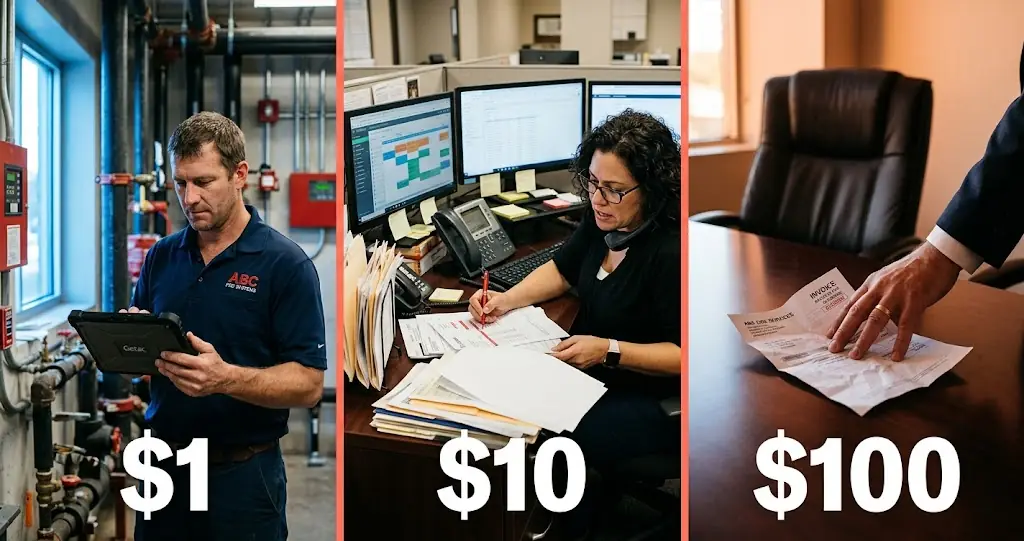
Manufacturing figured this out in 1979. Philip Crosby called it the 1-10-100 rule: a defect caught at the source costs $1 to fix. Caught in review, $10. Caught by the customer, $100. Service contractors have the same economics. They just haven’t made the same shift.
The 1-10-100 Diagnostic
Same defect, three price tags.
Caught by the technician: $1 of attention before leaving the job. Caught by the office: $10 of correction time and delayed cash. Caught by the customer: $100 of disputes, credit memos, churn, and litigation.
$1 stage: at the source. What percentage of work orders leave the field complete? Correct billing codes, compliance docs attached, labor hours accurate. If the answer is “we don’t know,” that tells you everything. You don’t have the instrumentation to see the problem at its cheapest stage. Every defect that leaves the field becomes a $10 or $100 problem by the time anyone notices.
$10 stage: internal review. When a defect reaches this stage, it doesn’t just get fixed. It gets handed off. Someone flags it, someone chases the tech for clarification, someone corrects the billing code, someone adds the missing material charge. Each touch costs time and delays the invoice. Multiply that across every defective work order in the queue, and across every company you’ve acquired. It never shows up as a line item called “rework.” It shows up as G&A that won’t flex down.
$100 stage: customer and compliance. What’s your dispute rate? Credit memo volume? Documentation callbacks? In regulated trades, those callbacks aren’t just billing problems. They’re liability exposure. Revenue earned in the field that never reaches the P&L because the record couldn’t support the invoice. In diligence, this isn’t “minor process issues.” It’s QoE adjustments that shrink your EBITDA base, systems risk that tightens your multiple, and legal exposure that kills deals entirely. Nobody calls it a work order problem, but it lands on your purchase price.
The catch-and-patch trap
“The $10 cost looks like the cost of doing business because nobody’s asking why it’s so high.”
If you run that diagnostic honestly, most of your defects are getting caught and fixed at the $10 stage. Not fixed when they cost $1. Not all making it to the customer at $100. Absorbed in the middle by the review team. And you’re not stuck there because your team isn’t trying. You’re stuck because the $1 defects never surface when they cost $1 to fix. Someone is absorbing them one at a time when they cost $10, and the only thing that reaches your P&L is the unidentified, aggregate $10 cost. That’s the catch-and-patch trap.
Every service company has a version of her. The coordinator who’s been there for years. Knows which techs skip the material log, which billing codes the system maps wrong, which customer contracts trip people up. She’s the reason the work order process works at all, despite being broken.
The problem isn’t her. It’s that everything she knows lives in her head. Not documented, not systematized, not feeding back to the field. A defect lands on her desk, she patches it, and the cost disappears into G&A. Even companies with SOPs? Those docs cover maybe 20% of what actually happens between field completion and invoice.
Her fingerprints are on all three stages. The $1 problems don’t exist on any report because she fixes them before they hit a report. The $10 cost looks like the cost of doing business because nobody’s asking why it’s so high. The $100 problems look like one-off customer issues because nobody’s tracing them back to the defect that started the chain.
Open or acquire a new division and her knowledge is trapped in one location while problems multiply everywhere else. Close an acquisition and every company you bring in has its own version of her, with her own undocumented fixes. Consolidate roles, and every workaround they’ve built disappears with them. The process was always broken. The people compensating for it are gone. You can’t outgrow the catch-and-patch until you’ve systematized what they know.
The $1 Fix (That Starts at $10)
You can’t inspect quality at $1 from the office. The tech is already on the next call. The work order is already in the queue. The first place you have systematic visibility into field quality is the $10 review stage.
That’s not a problem. That’s the opportunity.
Manufacturing didn’t solve quality by watching every worker’s hands. Six Sigma saved GE $12 billion and Motorola $17 billion by moving quality verification from the end of the line to the point of production. QC stopped being a pass/fail gate and became a diagnostic. What’s breaking, where it starts, how to fix the source.
“One way treats recurring failure as a cost of doing business. The other stops the bleeding at the source.”
Your review team already sees the patterns. Which techs write incomplete notes. Which billing codes get misapplied. Which service agreements trip people up. That’s where your $1 defects actually surface. The question is whether your team just patches what they see, or traces it back to the source and feeds that intelligence into your SOPs, your training, and your field standards.
One treats recurring failure as a cost of doing business. The other stops the bleeding at the source.
Start Here
You’re going to click the button below to copy this article (along with an AI prompt), paste it into your preferred AI tool, and let it build three targeted surveys for your team. It will ask about your business, recommend the right form tool, and walk you through setup end-to-end. No new software. No data project. Here’s what it’s going to build and why.
Survey your AR team. Your AR and billing team resolves disputes and processes credit memos every day. They know the patterns, but nobody’s asked them to name them. The objective: find out where your $100 problems originate. AI clusters their open-ended responses by root cause: field errors, review-stage breakdowns, or contract terms.
Survey your coordinators. Every coordinator is patching defects in real time. A survey across every office reveals which patterns are systemic versus which are local to one region or acquired company. The objective: surface the $10 fixes nobody tracks. That’s the difference between a platform problem and a site problem.
Survey your field techs. Don’t ask what they skip. Ask what gets dropped when they’re behind schedule, and why. The objective: find out what’s breaking at $1. AI clusters responses into SOP gaps, tool issues, training gaps, or unrealistic time expectations. For techs who won’t fill out a form, let them reply with a voice memo. AI transcribes and clusters the same way.
AI prompt to help you build and analyze surveys:
Click below to copy this article and prompt, then paste into your preferred AI tool.
These surveys tell you where the defects start. What you do with that information determines whether you keep absorbing $10 and $100 costs or start converting them into $1 fixes.
Shawn Mims is CEO of Taskora, building AI-powered operations tools for commercial service contractors. Previously VP Marketing at ServiceTrade. Co-author of “Money for Nothing: How a digital wrap earns more pay for less work.”
Sources
- Crosby, Philip B. Quality Is Free. McGraw-Hill, 1979. Cost of poor quality estimated at 15–25% of revenue.
- General Electric Company. Annual Reports, 1996–2000. $12B in cumulative Six Sigma savings over five years.
- Motorola, Inc. Motorola University, c. 2004. $17B in cumulative Six Sigma savings, 1986–2004.